
FSL
Dionaea muscipula - Cupped
₹ 900 / Piece
₹ 1,200
25%


Highlights
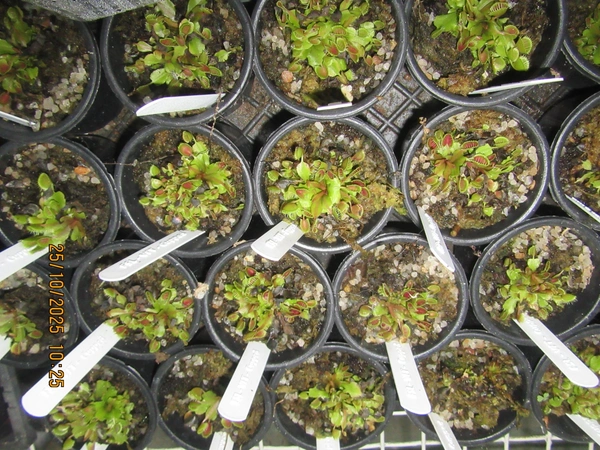
A unique morphological mutation where the traps are partially fused along one side, forming a “cupped” or bowl-like enclosure. The shape limits prey capture but enhances ornamental appeal. Leaves remain short and dense, creating a compact rosette. Exhibits bright green coloration with subtle red interiors under sunlight. Favored by collectors for its distinct non-functional yet aesthetic traps.
Venus Fly Trap ‘Cupped Trap’
(Botanical name: Dionaea muscipula ‘Cupped Trap’)
Cultivar Summary
-
Cultivar name: ‘Cupped Trap’ (also seen as ‘Cupped’). Plant Toolbox+2diflora.it+2
-
Species: Dionaea muscipula (common Venus fly-trap)
-
Unique trait: Distinctively rounded, cup- or bowl-shaped traps rather than the typical flat/hinged lobes. diflora.it+1
-
Registered cultivar status: Listed in the cultivar registry for Venus fly-traps. Wikipedia
Key Features & Appeal
-
The trap lobes are shaped like cups or shallow bowls, which gives a visually striking and unusual form compared to standard flat-lobed varieties. Carnivero
-
The traps are described as “bright red-centered with more rounded cup form” in one source. Plant Toolbox
-
Because of its novel trap shape, it appeals strongly to collectors and enthusiasts looking for distinctive cultivars.
-
Good candidate for tissue culture propagation and premium catalog listing: the morphological novelty adds value.
Ideal Growing Conditions (tailored for your tissue-culture / acclimation context)
-
Light: Provide strong light (outdoor full sun or intense artificial lighting) to promote good trap development and coloration.
-
Substrate: Use a nutrient-poor, acidic medium (e.g., sphagnum peat moss + perlite/sand) to mimic natural bog conditions.
-
Water: Use distilled, rainwater or reverse osmosis water (very low mineral content). Keep the substrate consistently moist (tray of water method works). Carnivero+1
-
Environment: Moderate humidity is sufficient; the novel trap shape does not require special humidity beyond what typical fly-traps require. Carnivero
-
Dormancy: As with all D. muscipula cultivars, ensure a cool winter dormancy period for health and long-term vigor.
-
Acclimation (from tissue culture): Because of the trap’s morphological uniqueness, ensure gentle acclimation of in-vitro plantlets to ex-vitro conditions — gradual increase of light intensity and stable substrate important.
Reviews and Ratings


No Customer Reviews
Share your thoughts with other customers
